
Thomas Boone Quaid: The Untold Story of Dennis Quaid’s Resilient Son
A Birth Surrounded by Hope and High Expectations
Thomas Boone Quaid entered the world on November 8, 2007, in Santa Monica, California, alongside his twin sister, Zoe Grace Quaid. For their father, veteran actor Dennis Quaid, and mother, real estate agent Kimberly Buffington, the twins represented the fulfillment of a long and difficult journey to parenthood. The couple had struggled with fertility issues for years, eventually turning to a gestational carrier to bring their children into the world. At birth, Thomas weighed a healthy six pounds and twelve ounces, and for the first few days, everything seemed perfect. The family settled into a routine of feedings, diaper changes, and the quiet joy that new parents experience, unaware that a nightmare was just days away.
The name “Thomas Boone” carries a certain traditional strength, perhaps chosen to ground the child in values beyond Hollywood glamour. Boone is a surname of French and English origin, often associated with frontiersman Daniel Boone, suggesting a spirit of independence and resilience. Little did anyone know that this infant would need every ounce of that frontier toughness within his first two weeks of life. His arrival was announced with joy on talk shows and in celebrity magazines, but Thomas did not remain in the public eye for long, as a medical crisis would soon shift the family’s focus entirely away from publicity and toward survival.
Looking back, the birth of Thomas Boone Quaid was the calm before a storm that would change his family forever. While most celebrity babies enjoy a gentle introduction to the world, Thomas’s entrance was quickly overshadowed by events that would make national headlines for all the wrong reasons. Yet, that very crisis would also reveal the depth of his father’s love and the strength of a family united in the face of terrifying negligence.
The Heparin Overdose That Shocked the Nation
Ten days after their birth, Thomas and Zoe Grace were taken to Cedars-Sinai Medical Center in Los Angeles for what should have been routine treatment of minor staph infections. Instead, a catastrophic medical error occurred that nearly cost both infants their lives. A nurse mistakenly administered an adult dose of the blood thinner Heparin—10,000 units—rather than the standard 10 units prescribed for newborns. This was not a small miscalculation; it was a thousandfold overdose. Within hours, the twins’ blood became so thin that it had the consistency of water, causing internal bleeding and putting them in immediate, life-threatening danger.
Thomas Boone Quaid’s tiny body began to show signs of distress rapidly. Medical staff had to act fast, administering protamine sulfate, an antidote that reverses the effects of Heparin. The situation was so critical that doctors later admitted they were not sure the twins would survive. Fortunately, the antidote worked, and after several tense days in the neonatal intensive care unit, both babies stabilized. The incident sparked a massive lawsuit, which was eventually settled for an undisclosed amount, but more importantly, it ignited a fire in Dennis Quaid that would lead to nationwide advocacy for patient safety.
For Thomas, the overdose left no permanent physical damage, but the psychological shadow of that event lingered over his early childhood. His parents became hyper-vigilant about medical care, and the family’s trust in hospitals was shattered. Three key outcomes emerged from this tragedy: first, the Quaid family received a confidential financial settlement; second, Cedars-Sinai publicly apologized and implemented new safety protocols; and third, Dennis Quaid became a leading celebrity voice for mandatory bar-code scanning of medications in hospitals. Thomas’s name became forever linked to a movement that has since saved countless other lives.
Dennis Quaid’s Advocacy and the Documentary Legacy
Rather than simply moving on with his life, Dennis Quaid turned his family’s trauma into a mission. He testified before the United States Congress, appeared on major news networks, and partnered with the Institute for Safe Medication Practices. His goal was simple: to demand that hospitals adopt bar-code verification systems for all medications, ensuring that the right drug and the right dose reach the right patient every time. Thomas Boone Quaid’s near-death experience became the emotional heart of this campaign, giving a human face to dry statistics about medical errors, which the Institute of Medicine estimates cause nearly 98,000 preventable deaths annually in the US alone.
The most significant outcome of this advocacy was the documentary “Chasing Zero: Winning the War on Healthcare Harm,” which Dennis Quaid both narrated and produced. The film features interviews with other families affected by medical errors and highlights the systemic failures that allow such mistakes to happen. While Thomas was too young to appear in the documentary himself, his story serves as its opening chapter. The film has been screened at medical conferences and hospitals nationwide, and it continues to be used as a training tool for healthcare professionals. In this way, Thomas Boone Quaid has saved lives without ever saying a word.
For Thomas growing up, his father’s advocacy was simply part of family life. He heard the name “Heparin” whispered in serious conversations and understood from a young age that he had survived something extraordinary. Yet, Dennis was careful not to let the tragedy define his son. The actor has stated in interviews that while he will always fight for patient safety, he wants Thomas and Zoe to live without the weight of that trauma. This balance between public advocacy and private healing is a delicate one, and the Quaid family has managed it with remarkable grace.
Growing Up as a Twin with Zoe Grace Quaid
The bond between Thomas Boone Quaid and his fraternal twin sister, Zoe Grace, is the anchor of his personal life. Being a twin means never being truly alone, and for these two, that connection has been especially vital given the unusual circumstances of their infancy. They share not just a birthday but a survival story, and that shared history has created an unspoken understanding between them. While many siblings drift apart during adolescence, Thomas and Zoe have remained close, attending the same schools and supporting each other through their parents’ divorce and the pressures of having a famous last name.
Unlike many celebrity twins who seek joint publicity, Thomas and Zoe have chosen the opposite path. They are rarely photographed together, and when they are seen in public, it is usually during low-key outings like grocery shopping or grabbing coffee. In 2025, reports emerged that Zoe was working as a camp counselor, a normal teenage job that speaks volumes about how the twins were raised. There is no reality show, no joint Instagram account, and no desperate grasp for fame. Thomas seems to have followed his sister’s lead in valuing substance over appearance. They have mastered the art of being unremarkable in a town that worships the remarkable.
Three things define their twin dynamic: mutual protection, shared humor, and a united front against unwanted attention. Friends of the family describe them as each other’s biggest cheerleaders, with Thomas often quietly supporting Zoe’s interests and vice versa. When their parents divorced in 2018, the twins leaned on each other heavily, navigating the custody schedule and the emotional ups and downs as a team. Today, as they approach full adulthood, that bond remains unbroken. In a world that often tries to divide siblings for entertainment value, Thomas and Zoe Grace Quaid stand as a testament to the quiet power of twin loyalty.
Life After Divorce and Blended Family Realities
The marriage between Dennis Quaid and Kimberly Buffington was far from smooth, featuring multiple separations, reconciliations, and legal filings before the divorce was finalized in 2018. For Thomas Boone Quaid and his sister, this meant growing up in a divided household. Court documents from the divorce proceedings revealed that Kimberly was granted 75 percent physical custody of the twins, meaning Thomas spends the majority of his school year living with his mother in Los Angeles. Dennis receives regular visitation and remains an active presence, but the primary day-to-day parenting falls to Kimberly, who has worked hard to give her children a stable, grounded upbringing away from Hollywood’s excesses.
The divorce settlement also included financial provisions for the twins, including child support and the establishment of trust funds. While exact numbers have never been made public, it is safe to assume that Thomas will never want for financial resources. However, money does not replace presence, and Dennis has made a concerted effort to be involved in his son’s life. He has been spotted at Thomas’s school events and has spoken in interviews about the importance of being a present father despite his busy filming schedule. The arrangement is not perfect, but both parents have prioritized the children’s well-being over their personal grievances, and that maturity has served Thomas well.
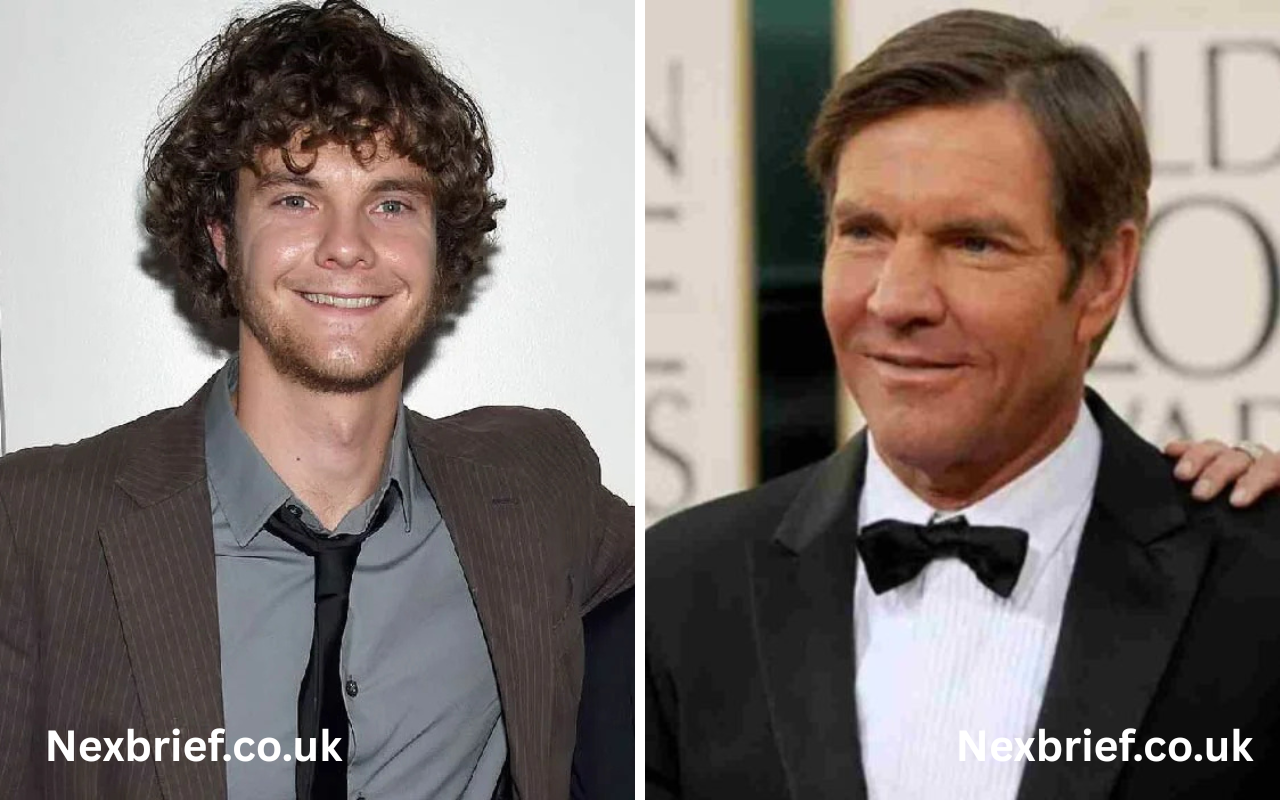
In addition to his parents, Thomas has a famous half-brother, Jack Quaid, from Dennis’s previous marriage to Meg Ryan. Jack, born in 1992, is best known for his roles in “The Boys” and “The Hunger Games.” Despite the fifteen-year age gap, the half-brothers share a warm relationship. Jack has spoken fondly of his younger siblings, and Thomas reportedly looks up to Jack as a role model, even though he has chosen not to follow him into acting. This blended family—with its divorces, half-siblings, and complex custody schedules—functions with surprising harmony. For Thomas Boone Quaid, family is not defined by traditional structures but by genuine love and mutual respect.
Choosing Music and Creativity Over Hollywood Lights
With a father who has starred in dozens of major films and a half-brother climbing the ranks of Hollywood stardom, one might assume Thomas Boone Quaid would naturally gravitate toward the family business. That assumption would be wrong. According to multiple sources close to the family, Thomas has little to no interest in acting. Instead, he has found his creative outlet in music. He is reportedly learning to play the guitar and has developed a passion for songwriting. Unlike the bombastic energy of a film set, music offers him a quieter, more introspective form of expression, one that does not require him to bare his soul to millions of strangers.
His interest in photography has also been noted by family acquaintances. Thomas enjoys capturing moments rather than being the subject of them, which aligns perfectly with his overall personality. Two important details emerge here: first, he has never made a public appearance at a film premiere or industry event unless forced to by family obligation; second, he has no known agent, manager, or publicist. These are not the actions of a young man waiting for his big break. They are the actions of someone who genuinely wants a different life. Music and photography allow him to be creative without sacrificing his privacy, a balance that acting could never provide.
It is worth noting that Dennis Quaid himself is a musician, having fronted the band Dennis Quaid and the Sharks for years. So while Thomas is rejecting his father’s acting career, he is embracing his father’s musical side. This is a subtle but important distinction. Thomas is not rebelling against his father’s entire artistic legacy; he is simply choosing the part that fits him best. He plays for himself, not for an audience, and that purity of intent is rare in the children of celebrities. In an era where every creative output is expected to be monetized and shared, Thomas Boone Quaid’s private guitar sessions represent a quiet revolution.
The Importance of Staying Off Social Media
In 2026, it is almost impossible for a teenager to have no public social media presence. Yet Thomas Boone Quaid has achieved exactly that. There are no verified Instagram accounts, no TikTok dance videos, no cryptic tweets, and no Snapchat stories bearing his name. A search for his handle on major platforms yields nothing but fan pages and impostor accounts. This is not an accident; it is a deliberate, carefully maintained boundary. His mother, Kimberly Buffington, has been the enforcer of this rule, recognizing that once a child posts something online, it never truly disappears. For Thomas, the absence of a digital footprint is a gift that keeps on giving.
Three specific reasons explain this social media blackout. First, it protects him from the “nepo baby” criticism that has engulfed so many celebrity children. By not putting himself forward as a public figure, he denies critics a target. Second, it allows him to make normal teenage mistakes without fear of going viral. Third, it preserves his ability to have authentic relationships, where people like him for who he is rather than for his last name. These are not small advantages. In a world where digital oversharing has become the norm, Thomas’s silence is a strategic choice that prioritizes long-term mental health over short-term attention.
The few photos that exist of Thomas Boone Quaid are usually candid shots taken by paparazzi without his consent, and he is almost always looking away from the camera or walking with his head down. He does not court photographers, nor does he engage with fan accounts that repost his images. This consistent rejection of visibility has, paradoxically, made him more intriguing to the public. But Thomas is not playing hard to get; he is genuinely hard to get. His lack of engagement is not a publicity stunt but a lifestyle. For those who study celebrity culture, Thomas Boone Quaid is a fascinating case study in how to be famous for not being famous.
Looking Ahead to Adulthood in 2026 and Beyond
As of 2026, Thomas Boone Quaid has turned 18 years old. He has completed his high school education in the private school system of Los Angeles, and the world is waiting to see what he does next. Will he follow his half-brother Jack into acting? Will he pursue music professionally? Will he attend college, and if so, where? These questions are natural, but those who know Thomas best expect a continuation of his current trajectory: privacy, education, and a slow, deliberate entry into adulthood. He has no publicist, no announced projects, and no verified social media. By every measurable standard, he is simply a young man finishing high school.
Two likely paths have been speculated by entertainment journalists. One, he will attend a university, possibly on the East Coast, where he can study music or photography away from the Los Angeles bubble. Two, he will take a gap year to travel and explore his interests without academic pressure. What seems almost certain is that he will not sign an acting contract or launch a reality show. His parents have the financial means to support any educational or creative pursuit he chooses, and there is no pressure for him to earn an income immediately. This financial freedom is precisely what allows him to be patient and intentional about his future.
The legacy of Thomas Boone Quaid is still being written, but the opening chapters are clear. He is a survivor of medical negligence, the beloved twin of Zoe Grace, the son of a devoted father, and a young man who values his privacy above all else. In a celebrity-obsessed culture that demands access to every corner of famous families, Thomas has drawn a firm line. His future may include music, photography, or something entirely unexpected. But regardless of the specific path, one thing is certain: Thomas Boone Quaid will walk that path on his own terms, far from the flashing cameras that marked his dramatic entrance into the world.
Read More: Paige Shiver Michigan: The Untold Story of the Scandal, Sentence, and Search for Justice
The Quiet Dignity of a Private Life
There is a certain dignity in choosing obscurity when fame is offered to you on a silver platter. Thomas Boone Quaid could have easily cashed in on his last name. He could have launched a clothing line, starred in a family reality show, or simply posted thirst traps on Instagram to build a following. He has done none of those things. Instead, he has demonstrated a level of self-awareness and emotional maturity that many adults twice his age never achieve. He understands that attention is a drug, and once you start taking it, it is very hard to stop. By refusing the first dose, he has spared himself a lifetime of addiction.
This quiet dignity extends to his public appearances, which are rare and always low-key. When he is spotted, he is usually dressed in casual clothes, wearing headphones, and moving with purpose. He does not stop for autographs, nor does he engage with fans who recognize him. Some might call this rude, but it is more accurately described as self-preservation. He has learned from his father’s experience that fame is a hungry beast that devours everything in its path. By keeping his head down and his mouth shut, Thomas Boone Quaid has starved that beast where he is concerned.
In the end, the story of Thomas Boone Quaid is not a story about Hollywood at all. It is a story about resilience, about the power of family, and about the radical act of choosing a normal life in an abnormal situation. He may never be a household name, and he would consider that a compliment. He may never win an Oscar or a Grammy, and he would probably breathe a sigh of relief. His greatest achievement is not a film credit or a chart-topping single; it is his successful defense of his own inner peace. In a world that screams for attention, Thomas Boone Quaid whispers, and somehow, that whisper is louder than any shout.